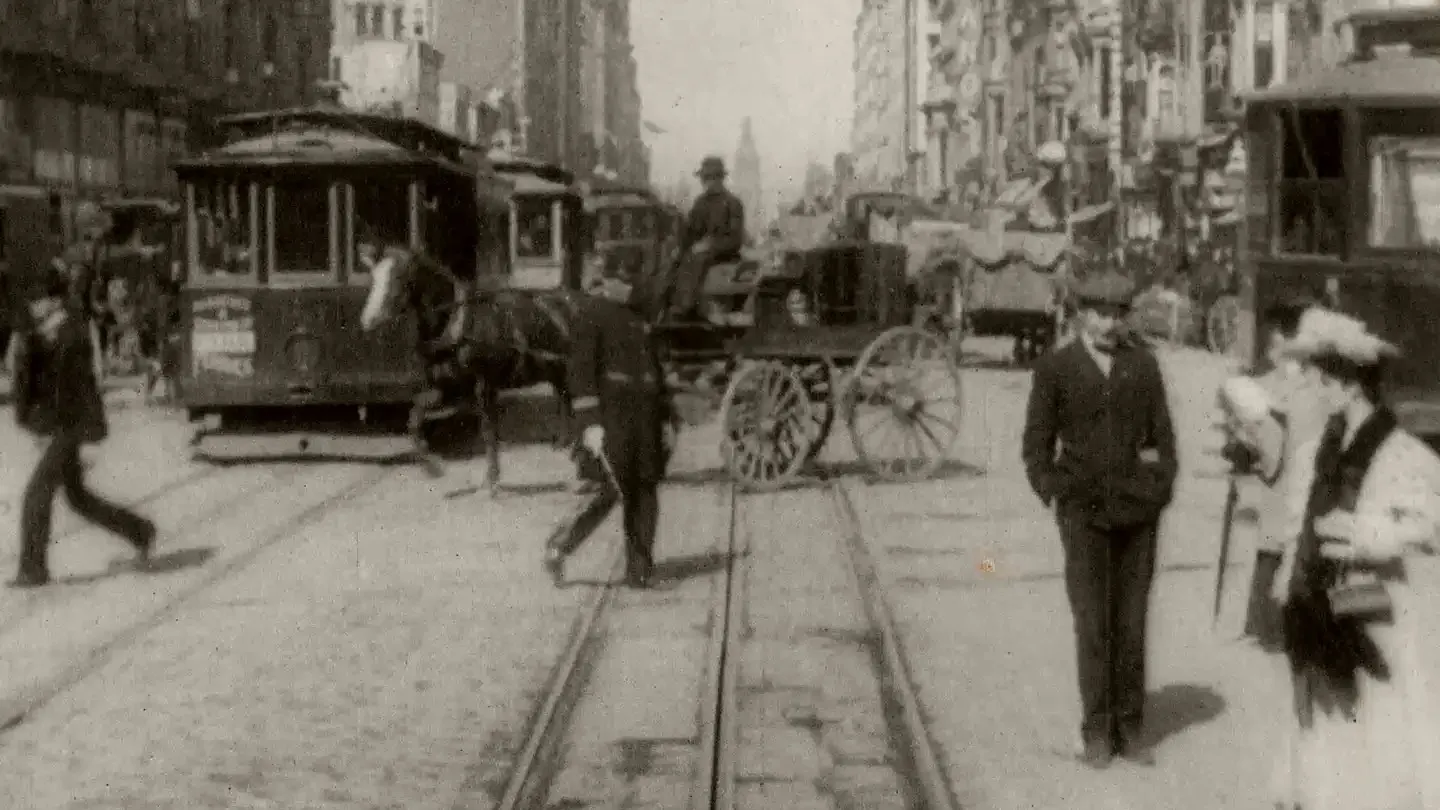
A camera on a cable car
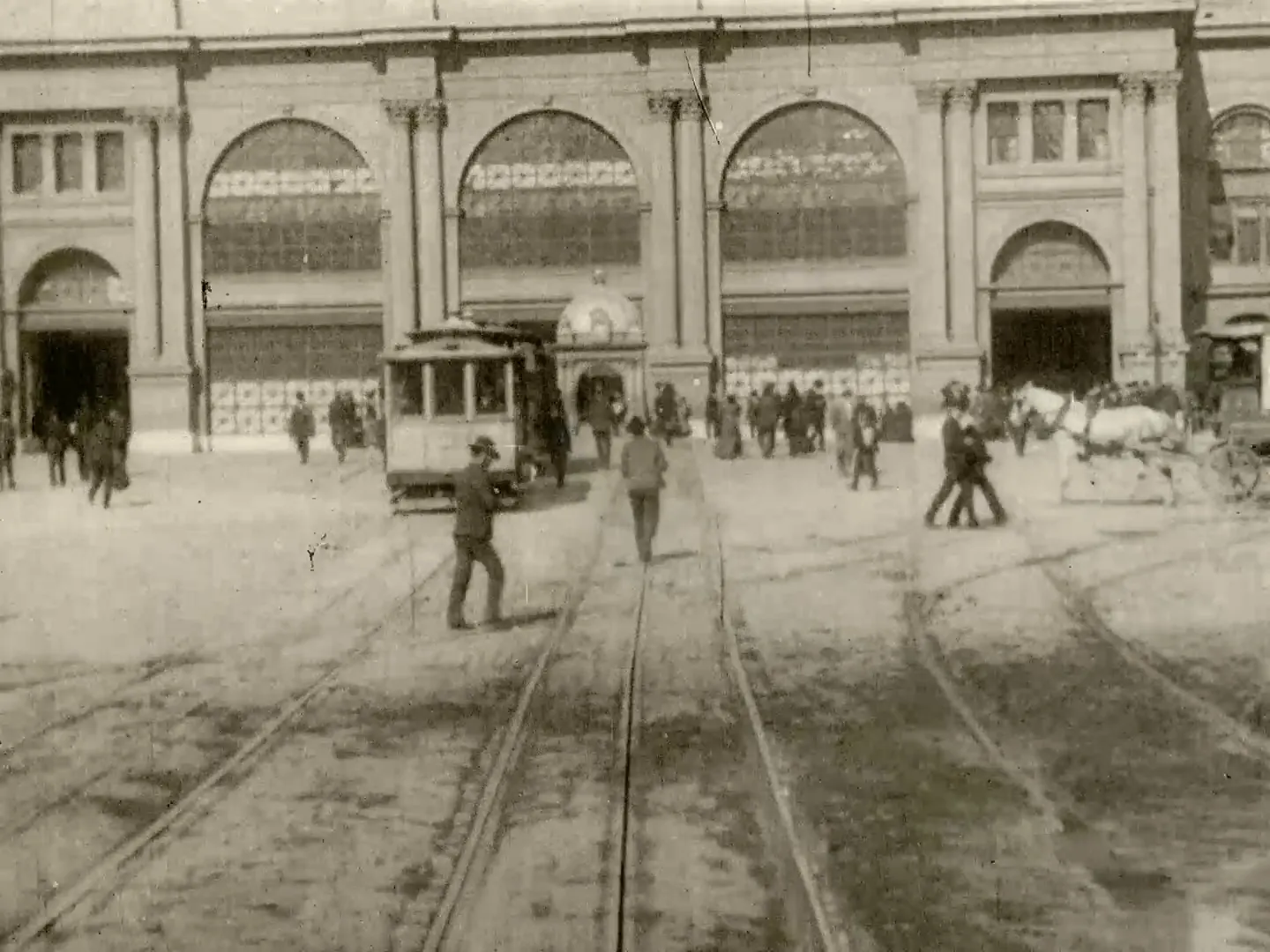
In the spring of 1906, a movie camera rode down Market Street, San Francisco's main thoroughfare, on the front of a cable car. The ride begins just west of Eighth Street, near the Miles Brothers' film studio at 1139 Market Street, and covers 1.55 miles to the Ferry Building at the foot of the street, where the car reaches the end of the line and turns on the turntable.
The Miles Brothers were Harry, Herbert, Earle and Joe Miles. They went into the film business in 1902–03 with a film exchange, renting films to theaters, and by 1905 they were making films of their own; by 1906 they had offices in San Francisco and New York. They advertised the Market Street film as made especially for the briefly popular Hale's Tours theaters, which were outfitted like railroad coaches to show scenic films. It survives today as A Trip Down Market Street, and it has been selected for the National Film Registry.
Puddles and a license plate
For years, people thought it was shot in 1905. The Library of Congress had dated it to September 1905, judging by how far construction had gone on buildings along the way and by the sun's position against the time on the Ferry Building clock.
The silent-film historian David Kiehn, of the Niles Essanay Silent Film Museum in Fremont, California, wasn't so sure. Watching the film over and over, he noticed water between the tracks: puddles from a recent rain. He searched the San Francisco newspapers and found no rain at all in September 1905, but plenty in the second half of March 1906. He traced the license plates of cars in the film, too: number 4867 had been registered in January 1906, and number 5057 in February. Then he found the Miles Brothers' advertisements for the film in the New York Clipper, a show-business paper.
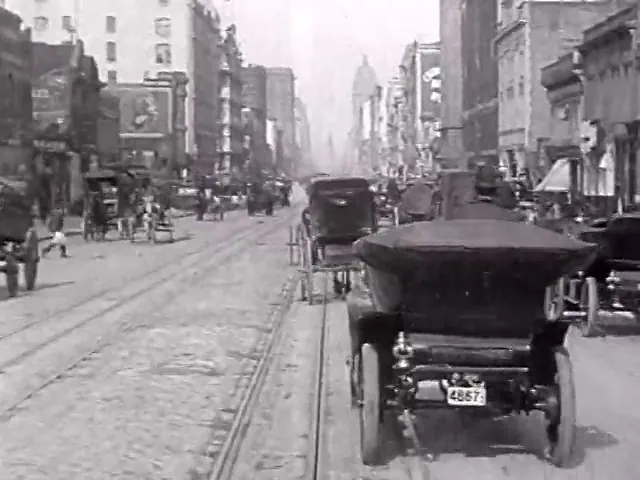
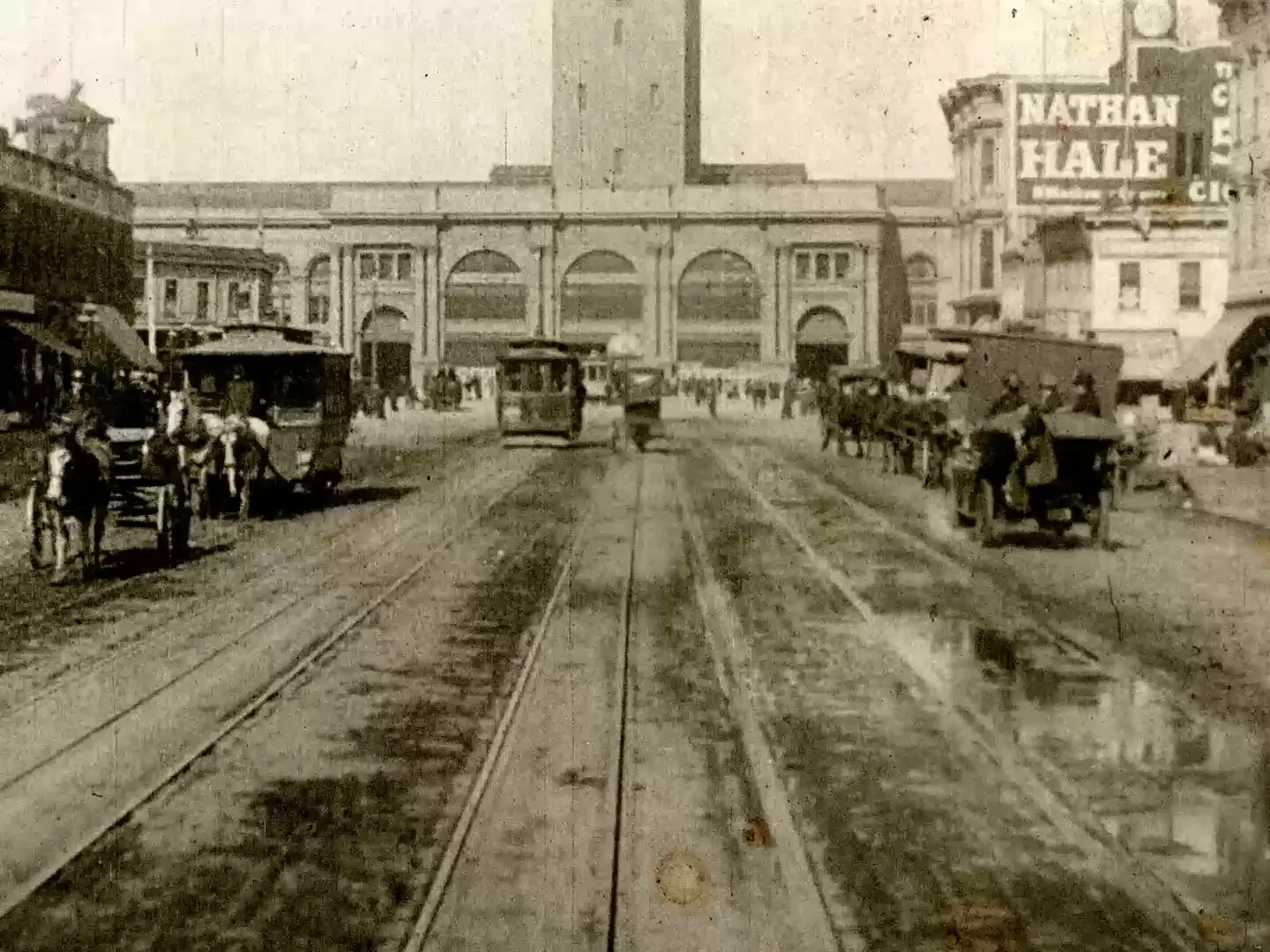
By Kiehn's research, the film was made on April 14, 1906, four days before the earthquake, and the Library of Congress catalogue now gives that date too. A 2011 study by Richard Greene in the journal Photogrammetric Engineering & Remote Sensing came to a different date: from the shadows on the Ferry Building's cornerstone in the film, Greene concluded that it was most likely shot between March 24 and 30, 1906, about three weeks before the earthquake. The Miles Brothers' own advertisement said only that it was made “just one week before” the destruction.
What the street shows
Market Street is 120 feet wide, and in the film it belongs to everyone at once. Cable cars run along it and electric streetcars cut across it, among horse-drawn buggies, carts and delivery wagons. People dodge the traffic on foot. A man gets off a cable car and crosses the street carrying a baby; a father appears with his son in a sailor suit; a commuter raises a hand, hoping to stop the car.
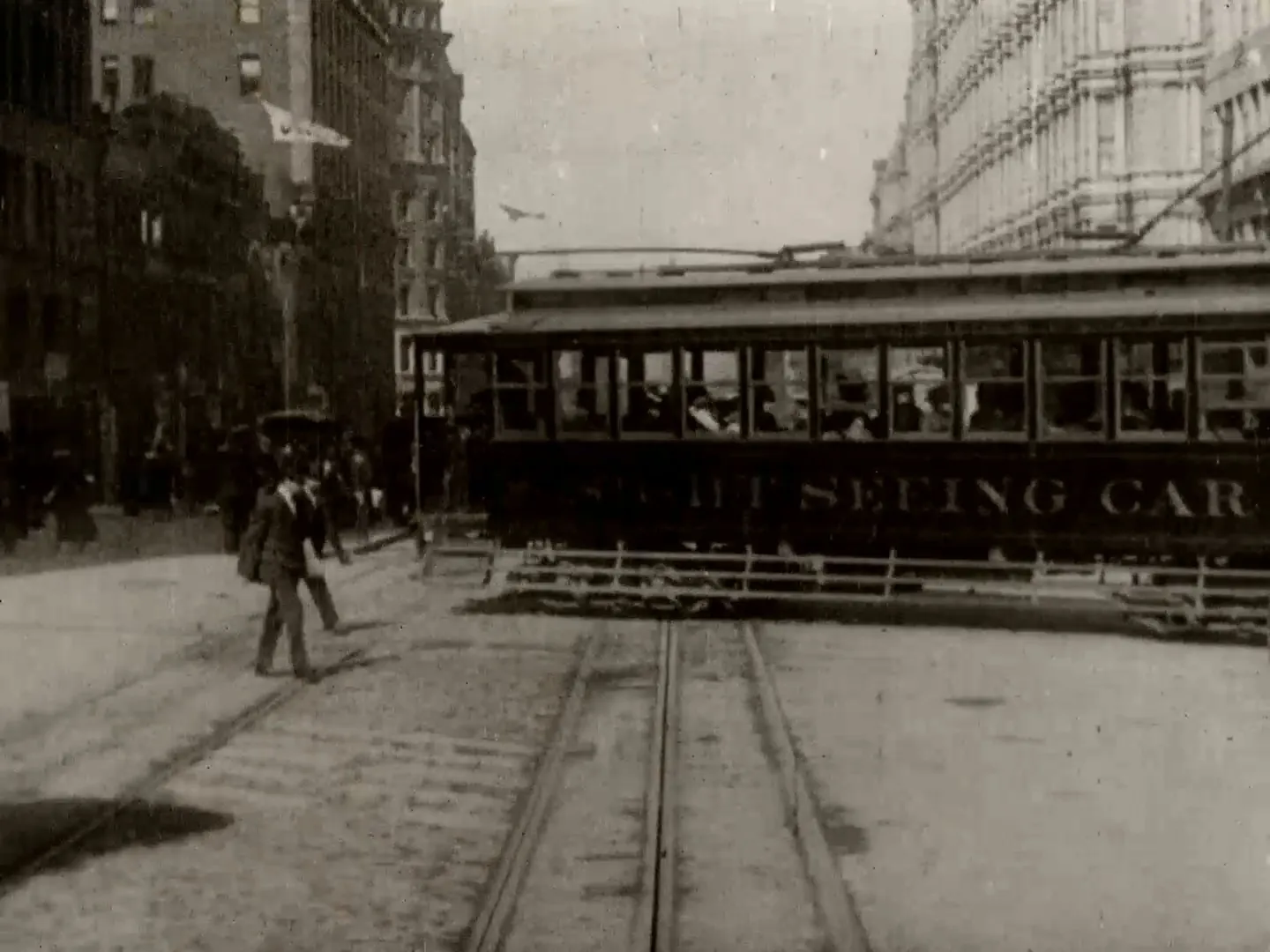
The motor cars are fewer than they look. Tracked through the film, almost all of them circle the cable car again and again, one of them ten times. The traffic appears to have been staged to make Market Street look like a prosperous, modern boulevard; in fact, horse-drawn vehicles were still the usual way to get about. Kiehn even identified one of the drivers, the chauffeur of car 4867; his essay for the Library of Congress gives the name as Jay Anway.
As the car nears the end of the line, the Ferry Building's clock reads 3:17.
The night before
On April 17, 1906, Harry and Joe Miles left San Francisco by train for New York, taking their film with them. At 5:12 the next morning, April 18, the earthquake struck. The shaking lasted some 45 to 60 seconds.
The fire that followed burned for three days and did substantially more damage than the earthquake itself. By one count, 28,188 buildings were lost, and about 225,000 people, from a population of about 400,000, were left homeless. A U.S. Army report recorded 498 deaths in San Francisco; after extensive research, Gladys Hansen and Emmet Condon estimated that more than 3,000 deaths were caused, directly or indirectly, by the disaster. The Miles Brothers' studio survived the earthquake, but it burned in the fire.
On the train, Harry and Joe heard what had happened and turned back with their equipment, sending the Market Street film on to New York.
What came after
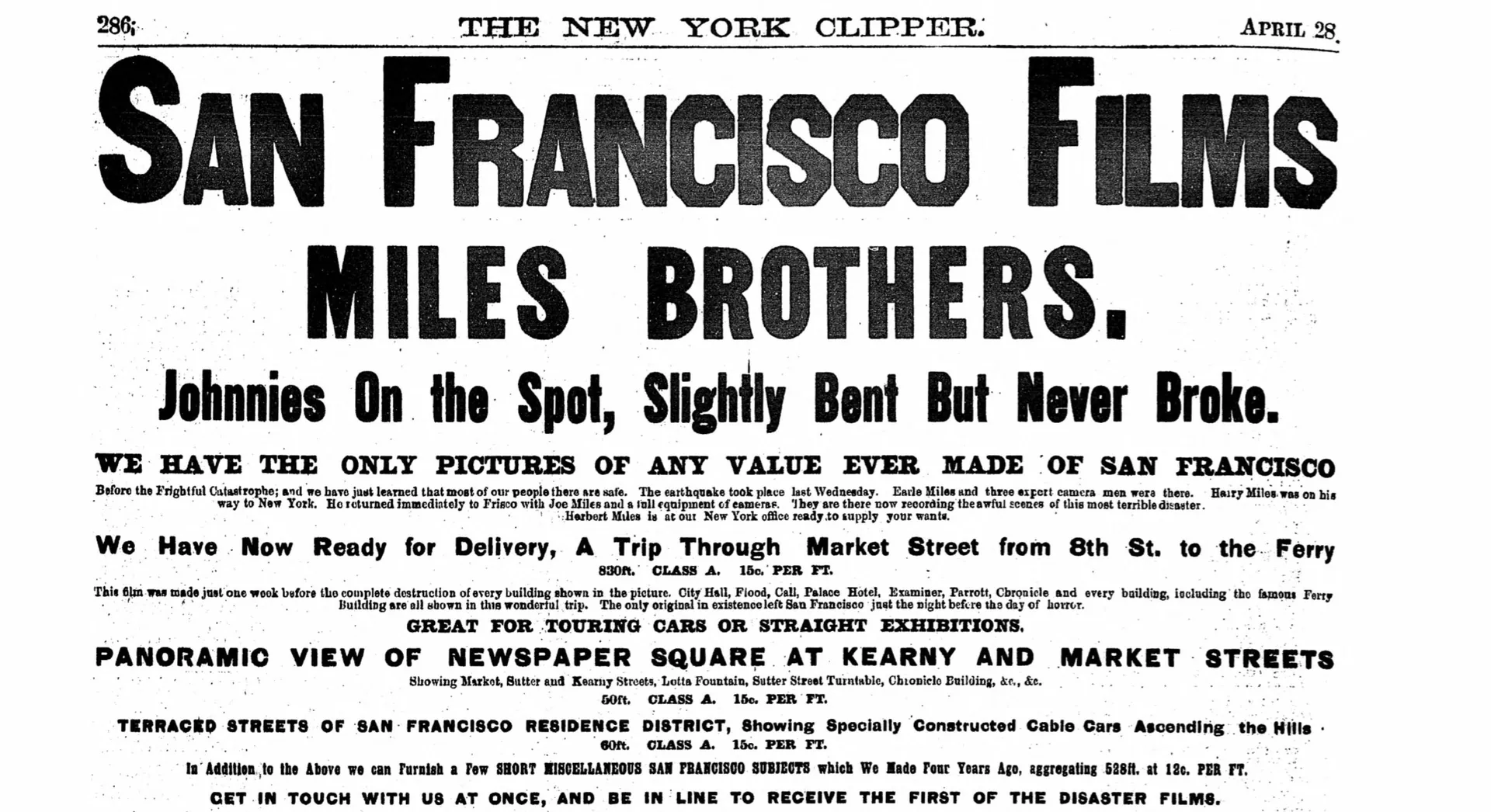
On April 28, 1906, ten days after the earthquake, the brothers advertised the film in the Clipper. “We have the only pictures of any value ever made of San Francisco before the frightful catastrophe,” the advertisement ran. Earle Miles had been in the city when the earthquake struck, it said, and Harry and Joe were back there, “recording the awful scenes of this most terrible disaster”. The only original of the Market Street film, it said, had left San Francisco “just the night before the day of horror”.
The same advertisement spoke of “the complete destruction of every building shown in the picture”. Not every one. At the end of the street, the Ferry Building survived the earthquake, and fireboats, Navy vessels among them, defended it from the fires. Ferries leaving from its terminals carried people out of the ruined city.
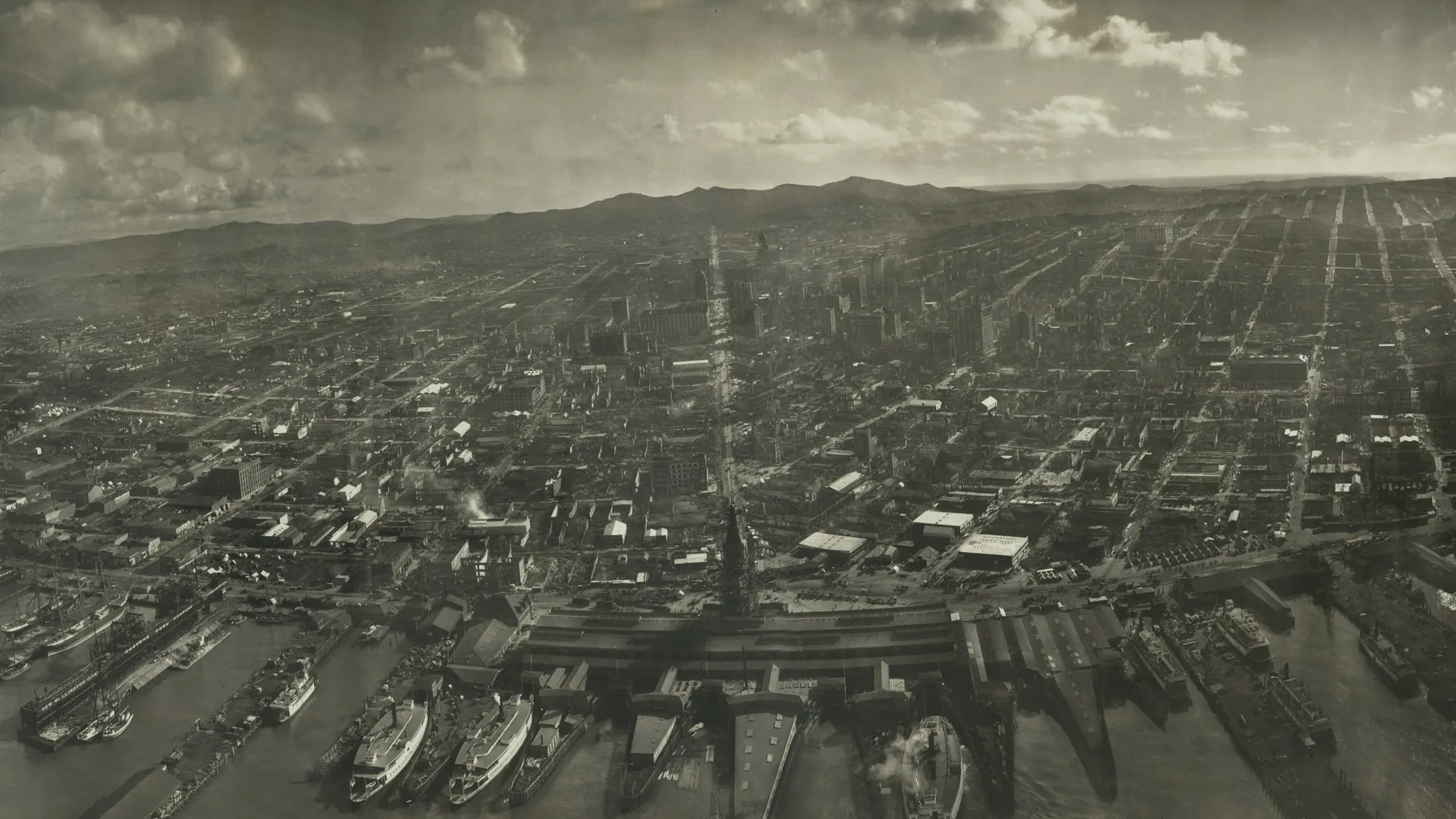
The Ferry Building did not come through untouched. The earthquake badly shook its tower: the military declared it unsafe, parts of its stone and brick walls were thrown down, and the tower had to be rebuilt. The building also survived the 1989 earthquake. It is still standing today: after a renovation it reopened in 2003, and by 2010 more than 10,000 commuters a day were using it again.